
Arabic in the age of AI
How can technology support our language and culture instead of crowding it out?
By Nabil Al-Hamad · September 19, 2026
Arabic at a turning point
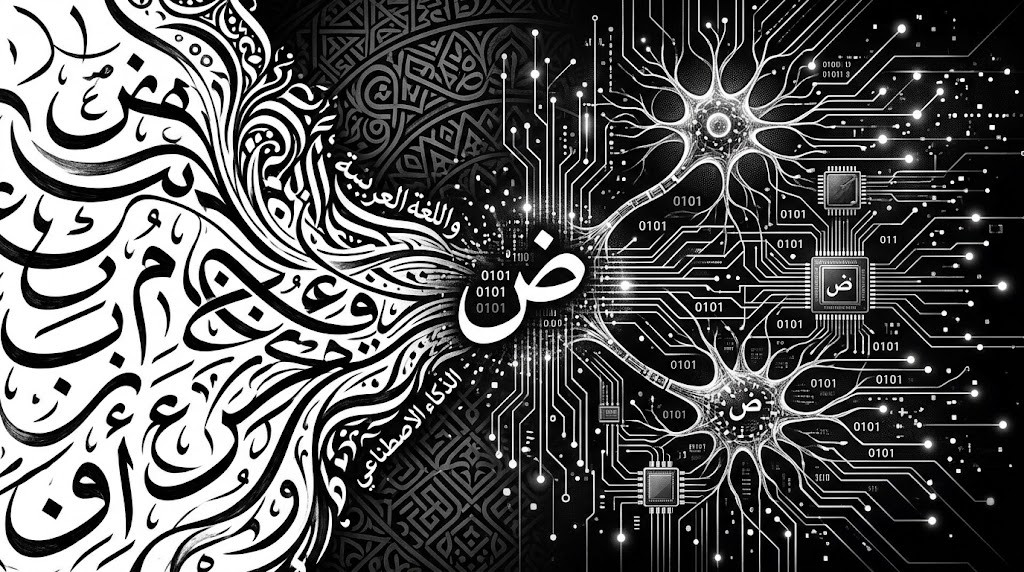
The encounter between Arabic and generative artificial intelligence stands at a complex civilizational and technological turning point. Arabic is more than a means of communication: it is a rich system of knowledge and derivation meeting technologies whose early foundations were shaped in very different linguistic environments.
This moment brings major opportunities, from automating dictionaries and digitizing heritage to narrowing the gap between Modern Standard Arabic and dialects. It also raises questions about linguistic sovereignty, the economics of model training, and the risk of losing nuance through general-purpose machine translation.
1. Arabic structure meets computational logic
Arabic differs from languages that often form words by appending affixes, such as English. It has a non-concatenative root-and-pattern morphology: roots interact with patterns to create related words, as in the family built around the Arabic root for writing.
This structure can be challenging when text is divided into small units called tokens. Many large language models use algorithms such as Byte-Pair Encoding (BPE), which may split Arabic words into pieces that do not carry a clear morphological meaning on their own. Arabic characters also occupy multiple bytes in UTF-8. Poorly suited tokenization can therefore use more tokens than English for the same idea, raise processing costs, and reduce how much Arabic text fits in a model's context window. Some estimates put the difference at two or three times in certain cases.
2. Paths forward and regional initiatives
Improving Arabic in artificial intelligence is no longer only an academic project; it is part of a broader discussion about the future of knowledge and culture. Key approaches include:
- Morphology-aware tokenizers: tools such as Farasa and CAMeL Tools help analyze and reconnect affixes, roots, and patterns, which can make Arabic word representation more efficient. Some estimates suggest token use could be reduced by up to 40%.
- Jais: an open-source language model launched through a UAE partnership. It focused on balancing Arabic and English and was trained from scratch on selected Arabic text.
- ALLaM: an initiative developed by the Saudi Data and Artificial Intelligence Authority (SDAIA), aiming to align models with linguistic, cultural, and heritage standards.
- Falcon, Fanous, and other open-source models: systems adapted with techniques such as reinforcement learning from human feedback (RLHF) to better handle dialects and religious and social contexts.
3. AI, rhetoric, and heritage
Arabic has a long association with eloquence and rhetoric, and its morphology carries subtle distinctions and rich figurative possibilities, as in the difference between the Arabic forms meaning “was able” and “could.” AI's encounter with Arabic literature and heritage therefore raises questions beyond technical accuracy:
- Flattening of rhetoric: models may produce a uniform middle register that lacks stylistic energy and metaphor. Preserving diversity of expression is therefore a shared responsibility for writers, developers, and readers.
- Bringing manuscripts to life: optical character recognition (OCR) and semantic analysis can help read and catalog hundreds of thousands of manuscripts, opening new possibilities for research and linguistic scholarship.
- The future of dialects: will technology push toward a globalized Standard Arabic, or help document and represent dialects digitally? Natural-speech processing offers new ways to preserve dialects, and models can code-switch between dialect and Standard Arabic according to context.
4. Building a strong Arabic presence in the age of AI
Arabic's place in the age of artificial intelligence is not merely a technical matter; it is a commitment to keeping the language a living vessel for thought and knowledge. Progress calls for moving beyond reliance on imported models by investing in open data and local cloud computing, and bringing linguists and AI engineers together.
Through that collaboration, the richness of Arabic word formation can inform tools that serve its speakers, expand knowledge production in their language, and preserve its diversity for future generations.